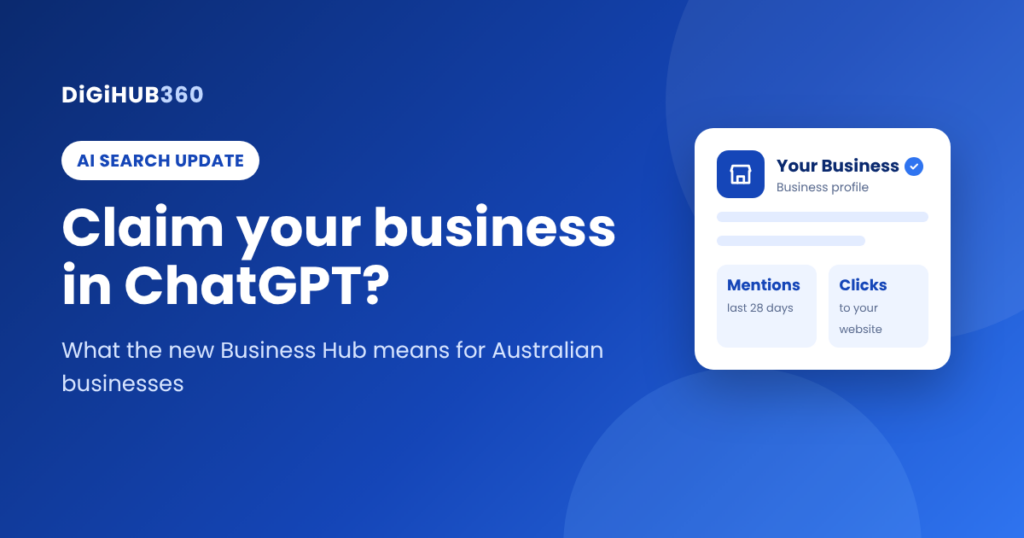
Google has had Business Profiles for years. Now ChatGPT wants something similar. On 10 November, OpenAI launched Businesses in ChatGPT, a new Business Hub where owners can claim their business, keep their details up to date and see how often ChatGPT mentions them.
If customers are starting to ask ChatGPT for recommendations instead of searching Google, that sounds like something you should jump on. The catch for Australian businesses is that the rollout is starting in the US, and plenty of the details are still settling. Here is what it is, who can use it right now, and what is worth doing this week regardless.
What is the ChatGPT Business Hub?
Think of it as a business listing inside ChatGPT. OpenAI describes it as a way to “claim your business to share what you offer, keep your information up to date, and understand and shape how you show up.” It sits at chatgpt.com/business-hub and also appears in the ChatGPT sidebar once you sign in.
According to OpenAI’s help article on setting up your business, once you have claimed and verified a business you can:
- Update your website, business description, category, logo and cover photo
- Add your delivery and return policies
- Upload a product feed (retailers can share product details, pricing and availability, including via Shopify)
- View Insights covering the last 28 days, including mentions, website clicks and “discovery topics”
- Add teammates or an agency to help manage it
OpenAI reviews changes before they go live, and notes that updates can take time to appear in a ChatGPT answer.
Can Australian businesses claim a profile yet?
This is the important part, and the honest answer is “not clearly, and for local businesses, probably not yet.”
- OpenAI says claiming “is initially available to eligible businesses with a website” and that availability depends on the business’s location and type.
- Local stores and restaurants “can currently claim only an existing U.S. listing.” So a Brisbane cafe or an Adelaide plumber is unlikely to get through today.
- Business Agents, the optional chatbot feature, are limited to eligible ecommerce and online service businesses in the US.
- OpenAI does not publish a list of supported countries, and Australia is not named anywhere in its launch material.
If you run an online store or service business, it costs you nothing but a few minutes to sign in and search for your business. You will quickly see whether it lets you continue. Just do not be surprised if it does not.
How claiming works (when it opens up)
The process has two parts, and it helps to have everything ready before you start.
1. Claim the listing
You search for your business by name, choose the right listing, then prove you are connected to it. OpenAI offers four ways: a code to your business phone (SMS or automated call), a code to your business email, a TXT record added to your website’s DNS, or connecting a Shopify store. OpenAI then reviews the claim and emails you a decision.
2. Verify your identity
Before you can publish changes or see Insights, you need to complete identity verification through a provider called Persona. OpenAI says you may need a government issued ID, business registration information and proof that you are authorised to represent the business. Once approved, your profile gets a blue verified tick.
Two practical notes. If your website was built by someone else, check now that you can actually log in to your domain’s DNS settings. And make sure your business email is one you control, not a former staff member’s inbox.
Will claiming help you show up more in ChatGPT?
Not directly, and OpenAI is upfront about it. Its launch page says: “ChatGPT continues to make independent recommendations and comparisons. Claiming does not guarantee higher placement or sales.” The help article adds that ChatGPT “may also use other sources” for information about your business.
That second point is the one to focus on. Whether or not you can claim a profile, ChatGPT is already forming answers about businesses like yours from what it finds on the web. Your own website, your Google Business Profile, directories and reviews all feed into the picture. If those sources are clear, consistent and current, you are in a far better spot than a competitor with a claimed profile and a messy website.
What the Insights will (and will not) tell you
For businesses that do get access, the reporting offers a new view of AI search. For an online business, OpenAI counts a mention when ChatGPT references your website, not just your brand name. For a local business, it counts when ChatGPT shows a result for that location. You also see website clicks and broad themes from answers that mentioned you.
What you will not see is the actual questions people asked or their conversations. OpenAI states that businesses “don’t receive individual prompts or consumer conversations.” So treat it like the AI reporting now in Google Search Console: useful for trends, not a full picture.
A quick note on ads
Search Engine Roundtable reported on 22 November that some users now see a “Connect an ad account” button in Business Hub, which links through to ChatGPT’s ad tools. Not everyone sees it yet. OpenAI says claiming, publishing an agent and advertising are separate, and that advertising does not influence ChatGPT’s independent answers.
What to do this week
- Sign in to ChatGPT, open Business Hub and search for your business to see whether claiming is available to you.
- Confirm you can log in to your domain’s DNS and that your business phone and email are ones you control.
- Check that your business name, address, phone, hours and services match across your website and Google Business Profile.
- Make sure your website clearly explains what you do, where you work, and your delivery and returns policies if you sell online.
- Ask ChatGPT a few questions a customer might ask, like “best emergency plumber in Adelaide”, and note whether you appear and what it says.
- Be wary of anyone offering to “get you verified in ChatGPT” for a fee. The claim process runs through OpenAI’s own Business Hub.
Frequently asked questions
What is Businesses in ChatGPT?
It is OpenAI’s Business Hub, launched on 10 November 2026, which lets eligible businesses claim a profile in ChatGPT, update their details, upload product feeds and see how often ChatGPT mentions them.
Can Australian businesses use the ChatGPT Business Hub?
Not clearly yet. OpenAI says availability depends on location and business type, local stores and restaurants can currently only claim existing US listings, and Business Agents are limited to US businesses. Australia has not been named as supported.
Does claiming my business improve my ranking in ChatGPT?
No guarantee. OpenAI says claiming does not guarantee higher placement or sales, and ChatGPT continues to make independent recommendations using other sources as well.
Can businesses see what customers ask ChatGPT about them?
No. Insights show aggregate mentions, website clicks and discovery topics over 28 days. Businesses do not receive individual prompts or conversations.
Want to know how AI tools see your business?
AI search is changing quickly, and most of what decides whether ChatGPT or Google’s AI answers mention you comes down to the basics being done well. If you would like us to check how your business currently shows up and what to tidy up first, get in touch with the DiGiHUB360 team. We will give you a straight answer.