
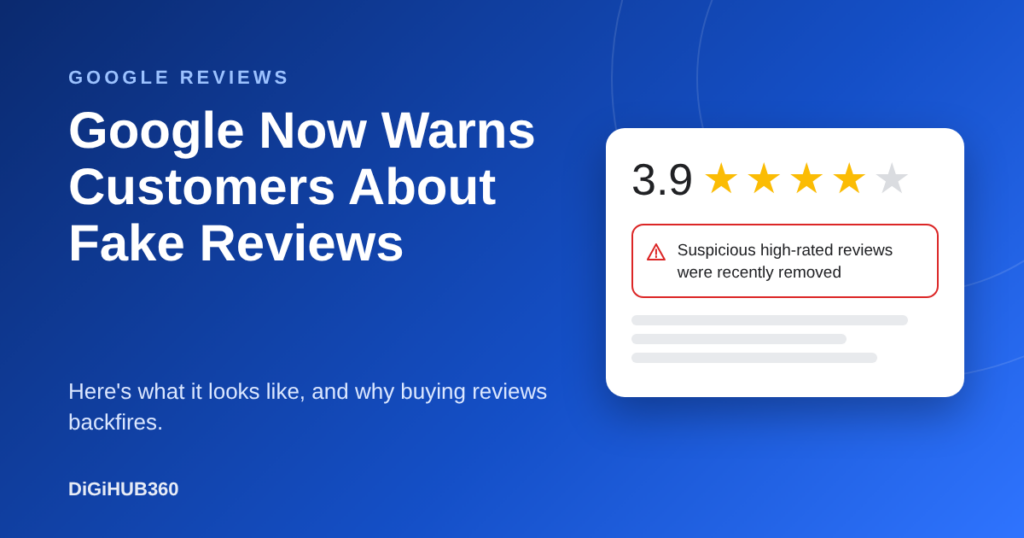
Picture a customer looking you up on Google Maps. They see your star rating, and right under it, a box with a red warning sign: “Suspicious high-rated reviews were recently removed from this place.”
That’s not a hypothetical. We came across this exact notice on a busy cafe listing recently, and it’s the clearest example we’ve seen of why buying Google reviews is a bad idea. Google doesn’t just quietly delete fake reviews anymore. It tells your customers it happened.
What customers actually see
Here’s the listing. We’ve blurred the business name, address and reviews, because the point isn’t to shame anyone. The point is what Google put on the page.
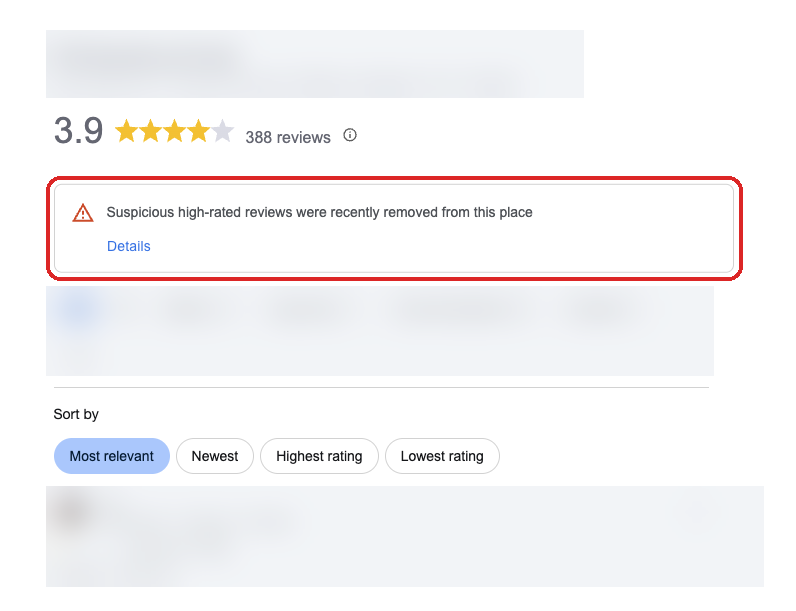
Notice where the warning sits. Not tucked away in a menu, but directly below the rating, the first thing people look at. Every person who checks that business now reads “suspicious” before they read a single real review.
What happens behind the scenes
Google calls these consumer alerts. When it detects suspicious review activity on a business, it can do three things:
- Remove or hide the reviews it believes are fake, which usually drops your rating straight away.
- Show a banner on your profile telling people suspicious reviews were removed.
- Switch off new reviews for a period of time, so nobody can leave a review at all, good or bad.
That last one is the part most business owners don’t expect. If a customer tries to leave a review, this is what they get:
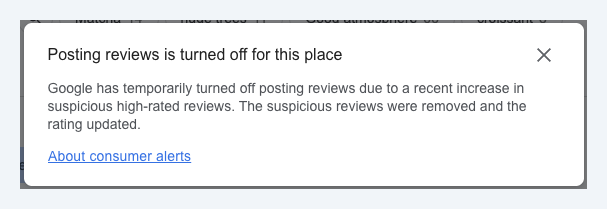
So the business that paid for five star reviews to look better now has fewer reviews, a lower rating, a public warning, and no way for happy customers to fix it. In April 2026 Google said it would go further, rolling out protections globally that remove fake content, pause new reviews, alert the owner and display a notification banner when it sees a sudden spike in spam reviews.
Google is catching more fakes than ever
If you think a few bought reviews will slip through, the numbers say otherwise. In its 2025 Maps safety update, Google reported it:
- Blocked or removed over 292 million policy violating reviews
- Removed over 13 million fake Business Profiles
- Placed posting restrictions on more than 782,000 accounts
Review sellers usually work in bulk, posting from the same networks of accounts across lots of businesses. That pattern is exactly what Google’s systems are built to spot. When one account in the network gets caught, every business it reviewed is exposed.
It’s also against the law in Australia
Google’s penalties are only half the story. The ACCC is clear that writing fake or misleading reviews is against the law under the Australian Consumer Law. That includes asking friends, family or staff to post reviews without disclosing their connection to you.
And the ACCC does follow through. In March 2024, online florist Bloomex was ordered to pay $1 million in penalties, partly for misleading star ratings and reviews on its website. A few hundred dollars of fake reviews is not worth that kind of risk.
How to get more reviews the right way
The good news is that genuine reviews aren’t hard to get. Most happy customers will leave one. They just need to be asked at the right moment.
Ask every customer, not just the happy ones
Make asking for a review part of how you finish every job. A Perth plumber can send a text with the review link once the invoice is paid. A Brisbane cafe can put a QR code on the counter. Asking everyone keeps it honest and builds a steady flow.
Make it easy
Grab your review link from your Google Business Profile and put it in your email signature, invoices and follow up messages. One tap to the review box gets far more responses than “search for us on Google”.
Reply to every review
Thank people for the good ones and respond calmly to the bad ones. Customers trust a 4.6 with thoughtful replies far more than a perfect 5.0 that looks too good to be true.
Be careful with incentives
If you offer anything in return for a review, the ACCC says it must apply whether the review is positive or negative, and you need to disclose it clearly. Google’s own policies are stricter again, so the safest approach is simply not to offer rewards for reviews.
We covered more of the basics in our earlier post, Do Not Buy Google Reviews: Why Authentic Feedback Matters.
What to do this week
- Check your own Google Business Profile for any warning banners.
- If anyone has ever bought reviews on your behalf, stop now and don’t add more.
- Copy your Google review link and add it to your invoices, emails and receipts.
- Pick one simple moment in your customer journey to ask for a review.
- Reply to any reviews from the past month that you haven’t answered yet.
FAQ
Can Google really tell if reviews are bought?
Often, yes. Google looks at patterns like sudden spikes in five star reviews, accounts that review many unrelated businesses, and reviews from the same networks. In 2025 alone it blocked or removed over 292 million policy violating reviews.
What happens if Google finds fake reviews on my profile?
Google can remove or hide the reviews, display a warning banner on your profile, and stop anyone posting new reviews for a period of time.
Is buying reviews illegal in Australia?
Yes. The ACCC says writing fake or misleading reviews breaches the Australian Consumer Law, and businesses have been ordered to pay significant penalties over misleading reviews and ratings.
What should I do if I get fake reviews I didn’t ask for?
Report them to Google straight away and keep a record. The ACCC recommends notifying the platform and asking for removal as soon as you become aware of fake reviews.
Want more genuine reviews?
A strong Google Business Profile is built on real customers, not shortcuts. If you’d like help setting up a simple review process or getting your profile in shape, get in touch with DiGiHUB360.